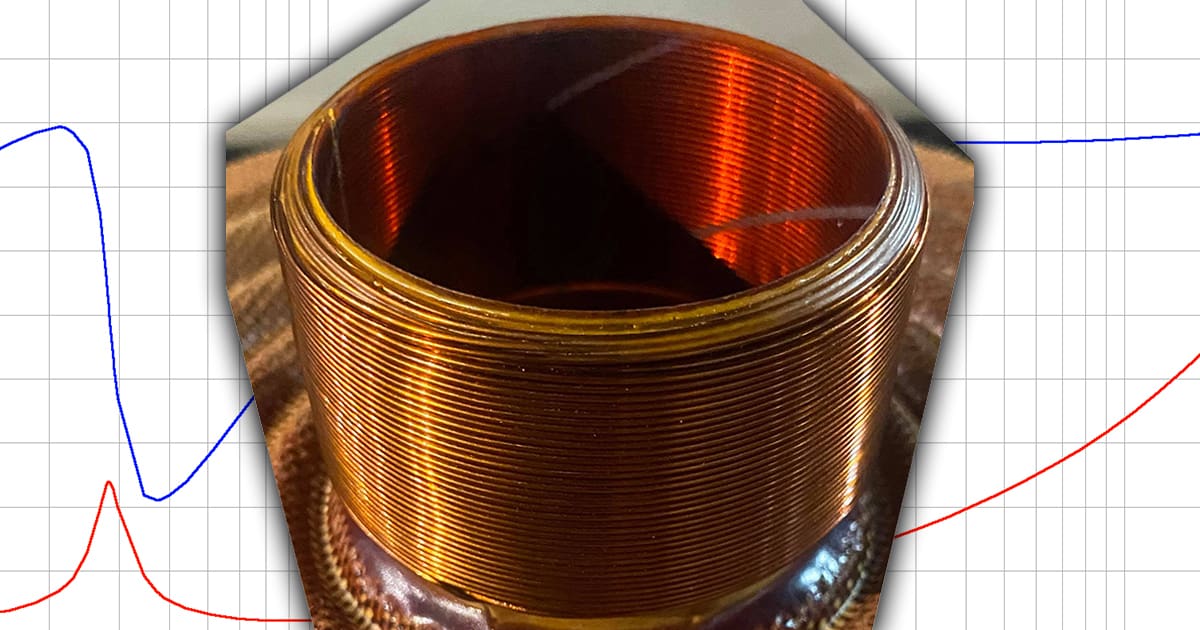
Even though most car audio speakers are chosen without regard for genuine performance, our goal of educating consumers remains steadfast: If you’re searching for a high-quality car audio system, understanding how speakers work and what differentiates the great from the mediocre is essential. In this article, we’ll explore the topic of speaker inductance, what affects it and why it matters to what you hear.
What Are Inductors?
As an introduction, you should review our full article on how inductors are used in car audio systems. This will give you a good overview of how they work.
In short, an inductor is a coil of wire that opposes the flow of alternating current. Direct current can pass through an inductor nearly unhindered. However, the magnetic field created in the inductor resists the change in polarity associated with AC signals. As such, inductors act like a frequency-dependent resistor to AC. We can use this characteristic as a benefit to limit the high-frequency information sent to a speaker or reduce noise in an electronic component.
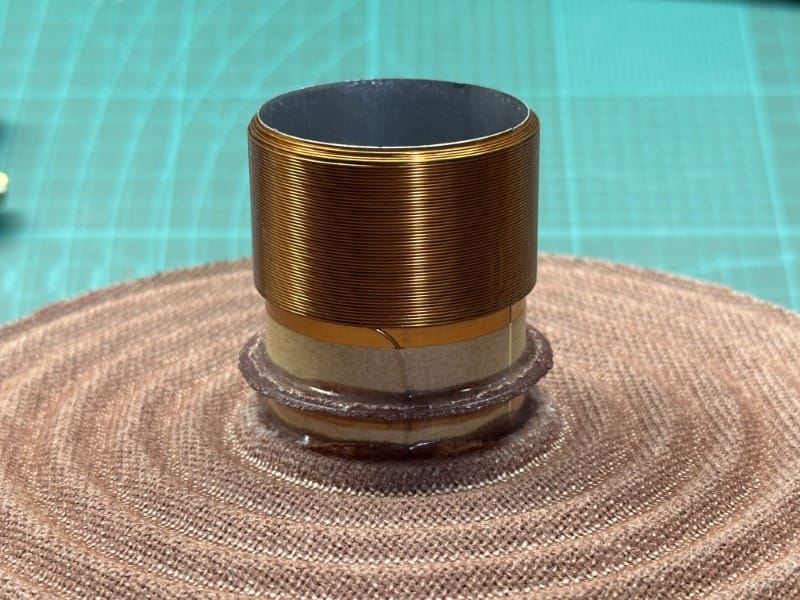
In this article, we’re going to talk about speaker inductance. Unfortunately, the voice coil in the center of a speaker is also an inductor. It’s a tightly wound coil of wire wrapped around a magnetically conductive core. Aside from a small air gap, it’s no different than the inductors we use in passive crossovers.
What Does Inductance Do?
As mentioned in the article linked above, inductor reactance, or opposition to the flow of AC signals increases as frequency increases. This results in less current flow. As such, if we have a speaker with a very inductive voice coil, less current will flow through the speaker at higher frequencies. This means the speaker produces less sound at high frequencies as the magnetic field that’s formed is weaker. Again, this is identical to wiring an inductor in series with a speaker to create a crossover.
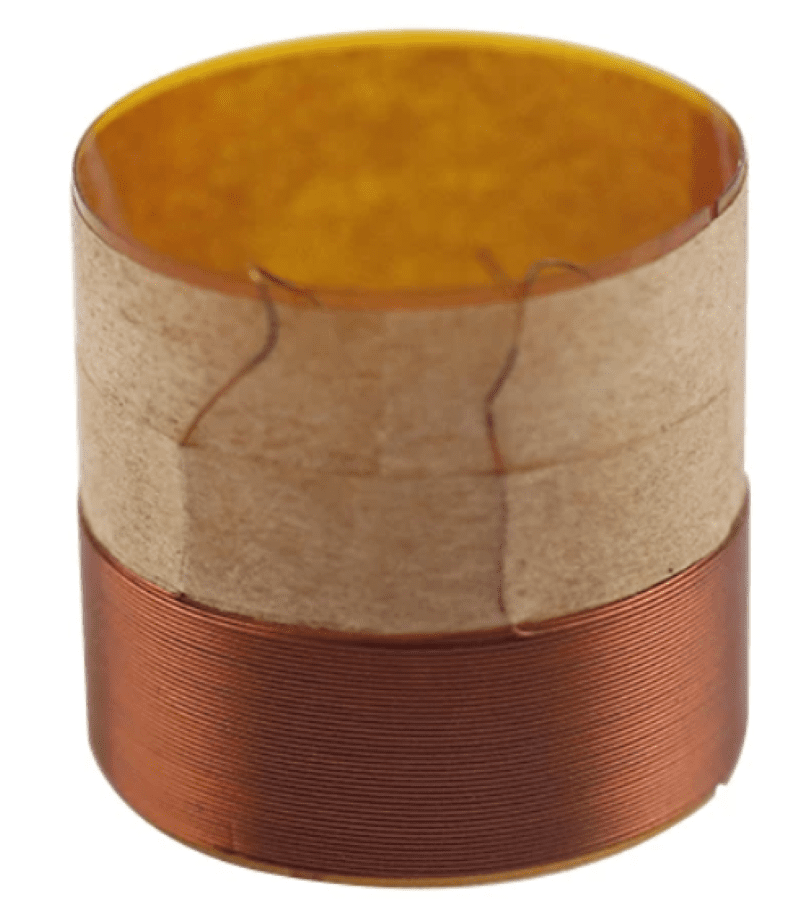
Subwoofers have the largest voice coils and, as such, typically have relatively high inductance values. As the number of layers in a voice coil increases, so does the inductance. For example, a 1.5-inch voice coil with four layers might measure 3.7 millihenries.
If a speaker designer wants to increase power handling, then a voice coil with more layers of wire will do the trick. The drawback is that the winding will have more inductance and, consequently, less upper bass and midbass output. The inductance also starts to cause a phase shift if the output of the signal as it behaves as a first-order low-pass filter. At the point where the inductance reduces output by 3 dB, the signal will be shifted by 90 degrees. This phase shift complicates getting the midbass to blend with the woofers.
The same thing happens with midrange speakers. If the design engineer wants more power handling, the driver needs a larger voice coil winding. The differences in inductance can be quite staggering and have a clearly audible effect on upper midrange output and how the driver blends with the tweeter.
Woofer Voice Coil Inductance
Let’s do some math in a spreadsheet to simulate what different voice coil inductances do to affect subwoofer output. We’ll start with a low-tech, high-power handling driver, as you’d find from popular internet-only brands. We quickly found a 4-ohm subwoofer rated for a few thousand watts of power handling with a voice coil impedance of 5.5 millihenries.
When manufactured by a reputable brand, a typical consumer-grade subwoofer rated for around 500 to 700 watts of power has around 3.7 millihenries of inductance. Now, if a company is serious about sound quality, it will add inductance-reducing features like a copper or aluminum shorting ring and a copper T-yoke cap. Drivers like this might only have 0.33 millihenry of inductance.
The chart below shows how the voice coil inductance attenuates the output of the three woofers. This graph doesn’t consider the cone’s mass, which, if significant, will also attenuate midbass and midrange output.
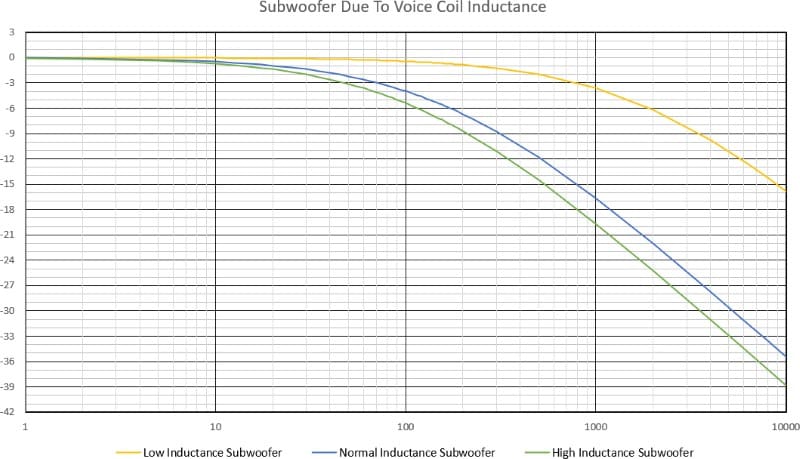
If we refer back to the discussion about a -3 dB point, we can see that the high-inductance woofer is -3 dB at a really low frequency of 47.8 hertz. The typical speaker with an inductance of 3.8 millihenries plays out to 71 hertz. Finally, the speaker with the inductance management features is flat-out amazing at 795 hertz.
Translating Measurements in Sound
So what do high-inductance subwoofers sound like compared with the low-inductance designs? It should come as no surprise that they don’t sound as tight. The reduction in midbass output attenuates upper bass frequencies. As mentioned, this complicates getting the subwoofer to blend with the woofers in the doors. For example, kick drums or large floor toms lack attack or impact. The low-frequency thud of a kick drum might be clear, but the higher-frequency information of the hammer hitting the skin will be lessened. Yes, we can equalize the system to play these frequencies at higher output levels, but the clarity of a high-inductance subwoofer simply outperforms low-inductance designs.
Inductance in Midbass Drivers and Woofers
The same inductance criteria that affect subwoofers can also reduce the upper midrange clarity of woofers and midrange drivers. Most audio system target response curves call for a flat response out to 3 or 4 kilohertz. We can see from the graph below that high-power-handling speakers without inductance management features like shorting rings start to roll off well below where they would cross over to a tweeter.
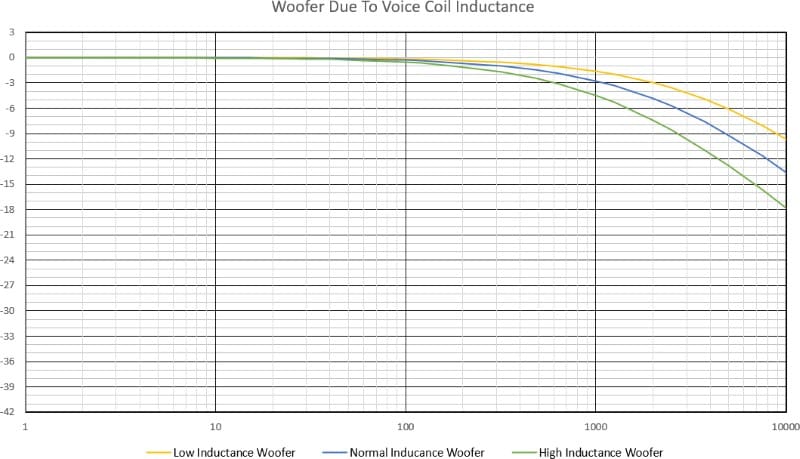
The green trace is a 6.5-inch woofer with an inductance of 0.43 millihenry. This a robust driver with a 50-mm voice coil and a continuous power handling rating of 150 watts. The second trace in blue represents a 6.5-inch woofer with a measured inductance of 0.24 millihenry. Finally, we have a third 6.5-inch woofer with an inductance of 0.13 millihenry. This driver has a copper pole piece cap and an aluminum shorting ring under the top plate. Based on their inductance, these drivers have -3 dB frequencies of 620, 1,100 and 2,100 hertz.
Start Your Speaker Shopping with Research
If you’re shopping for truly magnificent-sounding speakers, start the process with some research. Create a table of speaker options in the sizes you want, then look up their voice coil inductance. Of course, this is not the only feature to consider. A low Total Q (Qts) can also tell you a lot about how a speaker will sound. So can frequency response charts. Once you have a short list of car audio speakers, do some listening evaluations at local specialty mobile enhancement retailers. This head-start will help you choose a speaker system that sounds genuinely amazing.
This article is written and produced by the team at www.BestCarAudio.com. Reproduction or use of any kind is prohibited without the express written permission of 1sixty8 media.


Leave a Reply