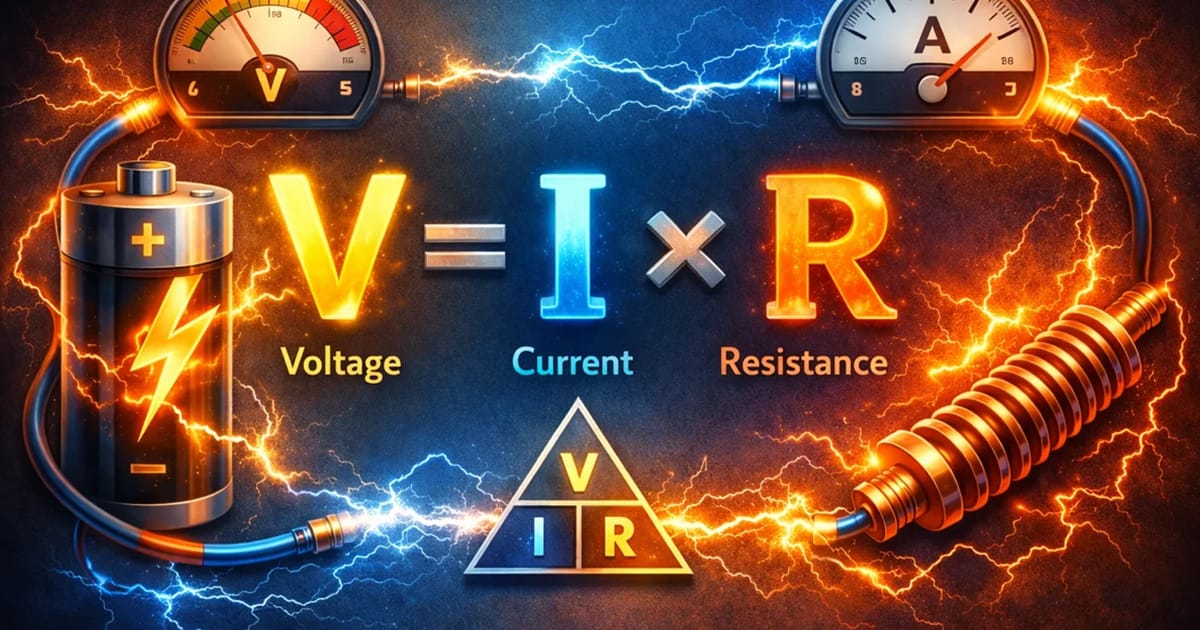
A customer walks into a car audio shop excited about their new 1,000-watt amplifier, only to discover weeks later that their system keeps cutting out, the amp gets burning hot, and their bass response is weak. The culprit? They used undersized power wire that couldn’t handle the current draw. This common mistake could have been avoided with a basic understanding of Ohm’s Law.
What Is Ohm’s Law and Why Does It Matter for Car Audio?
Ohm’s Law is the fundamental electrical principle that defines the relationship between voltage, current and resistance. In car audio, this law governs everything from how much power an amplifier produces to whether the electrical system can support it safely. The law states that voltage equals current multiplied by resistance (V = I × R), and this simple formula determines whether a system performs optimally or becomes a potential fire hazard.
The Three Components of Ohm’s Law: Voltage, Current and Resistance
Voltage pushes electrical current through a circuit. In car audio systems, the typical voltage measures around 14.4 volts when the engine runs. Current, measured in amperes (amps), represents the actual flow of electricity. Resistance, measured in ohms, opposes that flow. Higher resistance restricts current flow, while lower resistance allows more current to pass. These three variables interact in every car audio component, from the smallest tweeter to the largest subwoofer amplifier.
How Ohm’s Law Determines Power Wire Sizing Requirements

The relationship between power, voltage and current determines what gauge power wire a car audio system requires. When an amplifier produces 1,000 watts RMS at typical vehicle voltage (14.4 volts), Ohm’s Law reveals the current draw. Dividing watts by voltage shows that this amplifier draws approximately 70 amperes of current (1,000 W ÷ 14.4 V = 69.4 A). However, amplifier efficiency directly impacts actual current requirements. Class D amplifiers typically operate at 75 to 80 percent efficiency, while older Class AB designs operate at 50 to 60 percent efficiency.
For that 1,000-watt Class D amplifier with 75 percent efficiency, the actual current draw from the electrical system would be about 93 amperes (70 A ÷ 0.75 = 93.3 A). This calculation directly determines wire gauge selection. Running 93 amperes through undersized wire creates excessive resistance and dangerous heat buildup.
Industry standards specify 4 AWG wire for runs up to 20 feet at this current level. Longer runs demand larger wire to compensate for increased resistance. A 30-foot run to a trunk-mounted amplifier needs 2 AWG or even 1/0 AWG wire to maintain proper voltage at the amplifier terminals.
Voltage drop calculations based on Ohm’s Law help ensure the amplifier receives adequate voltage under full load. Professional installers work hard to maintain the highest voltage available at the amplifier terminals to prevent shutdown and performance degradation. Undersized wire acts like a resistor, converting electrical energy into heat instead of delivering it to the amplifier. This waste heat damages wire insulation, melts connectors and creates fire hazards.
Subwoofer Wiring Configurations and Impedance Matching
Different wiring configurations change the total impedance that an amplifier sees. A dual 4-ohm voice coil subwoofer presents a 2-ohm load wired in parallel or an 8-ohm load wired in series. Each configuration affects power output according to Ohm’s Law. An amplifier rated at 500 watts into 4 ohms produces 750 watts into 2 ohms or 250 watts into 8 ohms, assuming sufficient current delivery.
Why Proper Grounding Relies on Ohm’s Law Principles
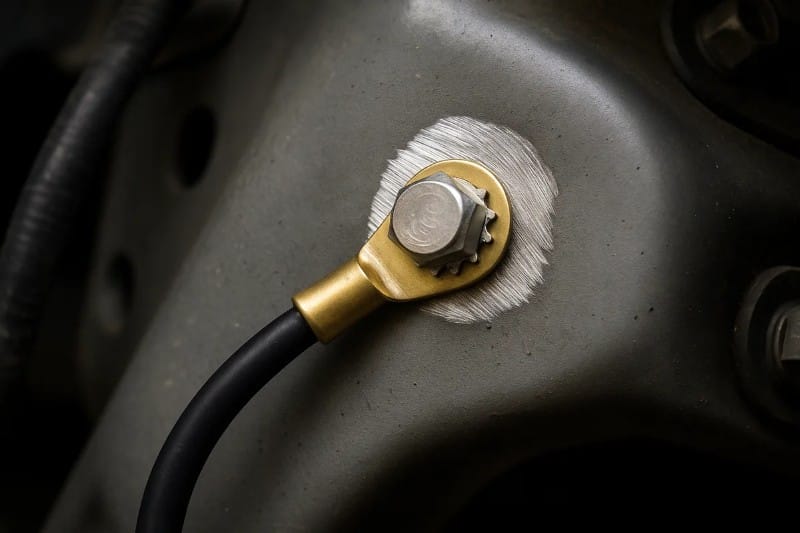
Ground connections complete the electrical circuit, and resistance in the ground path reduces system performance exactly like undersized power wire. A ground connection with 0.1 ohms of resistance carrying 50 amperes creates a 5-volt drop (0.1 Ω × 50 A = 5 V). This voltage loss directly subtracts from the voltage available to the amplifier, reducing power output and potentially causing thermal protection circuits to engage.
Quality ground connections require bare metal contact with minimal resistance. Paint, rust and dirt act as insulators that increase resistance. Professional installers sand mounting points to bare metal and use star washers to bite through oxidation. The ground wire must match the power wire gauge since it carries the same current. Multiple ground points for different amplifiers should connect to the same location to prevent ground loops that introduce noise.
Calculating Fuse Requirements Using Ohm’s Law
Fuses protect the electrical system by interrupting current flow when it exceeds safe levels. Proper fuse selection requires calculating the maximum current draw using Ohm’s Law. For the 93-ampere example, installers select a 100-amp fuse to provide protection while allowing for brief current peaks during musical transients.
The fuse rating must exceed normal operating current but stay within the wire’s current capacity. A 4 AWG power wire safely carries 100 to 125 amperes depending on insulation type and ambient temperature. Using a 150-amp fuse with 4 AWG wire eliminates protection since the wire could overheat before the fuse blows. Conversely, a 50-amp fuse would blow constantly during normal operation. Ohm’s Law calculations help ensure the fuse protects the wire while allowing full system performance.
Real-World Car Audio Applications of Ohm’s Law
These electrical principles guide every professional installation decision. Matching amplifier power to available electrical system capacity prevents dimming headlights and alternator failure. Selecting appropriate wire gauges ensures reliable performance. Diagnosing voltage drop issues restores lost performance. Systems designed with Ohm’s Law principles deliver years of reliable service.
Ready to upgrade your car audio system with confidence? Visit the BestCarAudio.com Dealer Locator to find qualified professionals who understand these critical electrical principles and can design a system that performs safely within your vehicle’s capabilities.
This article is written and produced by the team at www.BestCarAudio.com. Reproduction or use of any kind is prohibited without the express written permission of 1sixty8 media.


Leave a Reply