• Skip to primary navigation
  • Skip to main content
  • Skip to primary sidebar
  • Skip to footer

Precision Audio & Tint

Thomasville: (229) 233 5001Bainbridge: (229) 246 2111
  • Financing/Lease to Own
    • Easy Payments, No Credit Needed
    • $0 Down, 0% APR Financing
  • Our Work
  • Reviews
  • Facebook
  • Instagram
  • Request a Quote
  • About Us
    • Why Choose Us
    • Hours and Directions
    • Our Facilities
    • Virtual Tour Bainbridge Store
    • Virtual Tour Thomasville Store
    • Work for US
    • Gift Cards
    • Contact Us
  • Services
    • Car Audio
      • Backup Safety
      • Mobile Video
      • OEM Integration
      • Professional Installation
      • Smartphone Integration
      • Vehicle Navigation
    • Marine Audio
    • Motorcycle Audio
    • Remote Starters
    • Wheels & Tires
  • Window Tint
    • Film Types and Pricing
  • Customize Your Truck
    • Bed Covers
    • Floor Liners And Accessories
    • Grille Guards And Bumpers
    • Hitches
    • Leveling and Lift Kits
    • Jeep Parts And Accessories
    • Step Bars And Running Boards
    • Toolboxes
  • Brands
    • JL Audio
    • Kenwood
    • Pioneer
    • Fuel Wheels
    • Llumar Window Tint
    • Rockford Fosgate
    • Cam-Locker
    • Ranch Hand
    • Rough Country
    • WeatherTech
You are here: Home / ARTICLES / Do I Have To Use Both Coils on My Car Audio Subwoofer?

Do I Have To Use Both Coils on My Car Audio Subwoofer?

By BestCarAudio.com Leave a Comment

Subwoofer Coil

A while back, we took a look at the difference between single and dual-voice-coil subwoofers. In a nutshell, there is no benefit or drawback to either choice. The options exist so you can present the amplifier you have chosen with a load impedance that allows it to make power reliably. There have been many instances where consumers bring a subwoofer into a car stereo shop in hopes of using it in their vehicle only to find out it’s not the right impedance. They need a 4-ohm sub instead of a dual 4-ohm. The question then becomes, can you use just one of the voice coils? That’s a fair question, and it deserves a detailed answer.

Can You Use Only One Subwoofer Voice Coil?

If you look at the voice coil former and the winding of a single-voice-coil sub, you’ll find a single positive and negative connection. On a dual-voice-coil sub, there are two pieces of wire and two sets of connections. The coils can be wired in series, in parallel or individually to power the subwoofer.

Car audio installers can use a set of specifications called Thiele/Small parameters in conjunction with modeling software to predict the performance of a subwoofer in a specific enclosure. All subwoofer manufacturers provide these specifications with both coils in use.

The short answer about using one coil is no. Using one coil not only affects the thermal power handling capabilities of a subwoofer, but it also changes the strength of the magnetic field and alters the Thiele/Small specifications. Rather than explain the math involved in the change, let’s use an example.
Subwoofer Coil
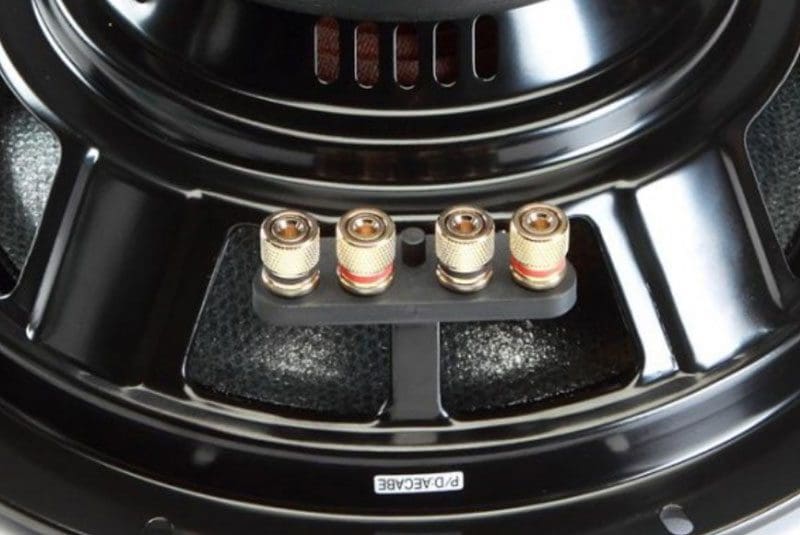
Some subwoofers have all four voice coil terminals together in a single block. This Sony XS-GSW121D is a great example.

Thiele/Small Parameter Changes

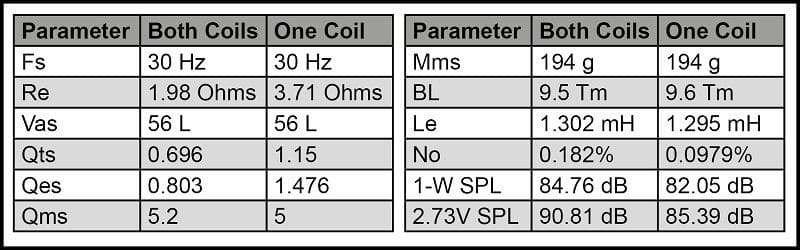
Let’s start by measuring the parameters of an inexpensive 12-inch dual-voice-coil subwoofer. We measured the subwoofer with both coils wired in parallel, then we disconnected one coil and repeated the test. The results are in the chart below:
Subwoofer Coil
Thiele/Small parameters for the same subwoofer using one voice coil, and both voice coils wired in parallel.

Sealed Enclosure Performance

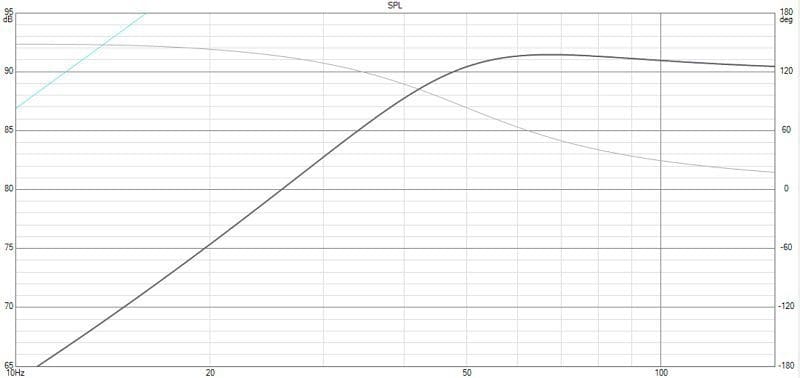
We modeled the subwoofer performance using both voice configurations in VituixCAD 2 software. We started with a simple sealed (acoustic suspension) enclosure with a net internal volume of 1.08 cubic feet. Graph 1 shows the output of the subwoofer with 2.83 V (which is 8-watts into a 4-ohm load) applied to the coil. The response is nice and smooth, with a good transition from the midbass region and very little ripple. The Qtc (Total Q Factor) for the system with both coils connected is 0.8. This is a good balance between low-frequency extension, efficiency and low-distortion operation. The black trace that slopes down on the left shows predicted SPL.
Subwoofer Coil
Graph 1 – 12-inch DVC in 1.08 cubic feet with both voice coils wired in parallel.

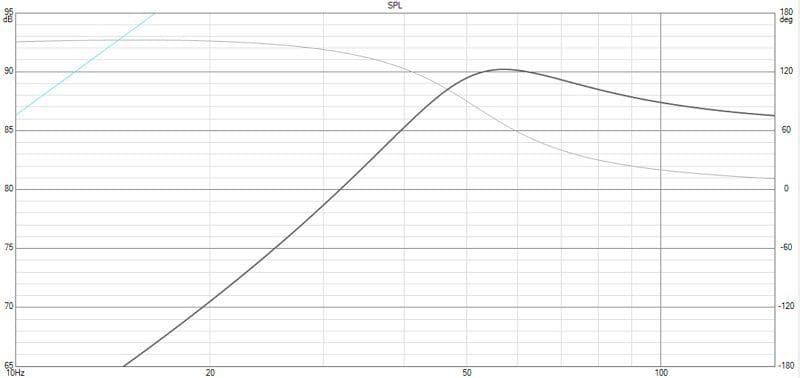
Graph 2 shows the response of the same driver when only one voice coil is connected. You can see that the overall output of the system has decreased significantly and that there is a lot more ripple (a big bump in the response around 57 Hz. It’s also worth noting that the total system Q has jumped to 1.18. This Qtc value is quite high and will add resonance and distortion to the system.
Subwoofer Coil
Graph 2 – 12-inch DVC in 1.08 cubic feet with only one of the two coils in use.

Vented Enclosure Performance

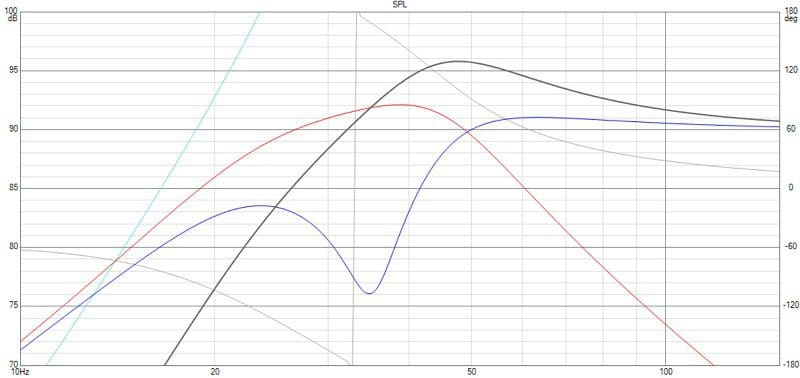
Next, we designed a vented (bass reflex) enclosure using the specs taken with both coils in parallel. We simulated a 2-cubic-foot enclosure with a vent tuned to 35 Hz. As you can see from Graph 3 below, using both voice coils results in relatively smooth performance across the entirety of the operating range. The system efficiency has increased dramatically as compared to the sealed enclosure, with a jump in predicted output from 87 dB to 94 dB with the same amount of power.
Subwoofer Coil
Graph 3 – 12-inch DVC in 2.0 cubic feet tuned to 35 Hz with both voice coils wired in parallel.

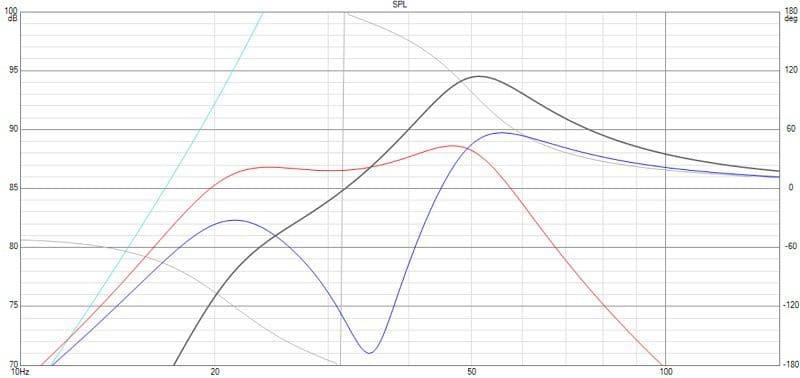
Finally, we can see in Graph 4 how poor the performance of the subwoofer is with only one coil connected. Output at 40 Hz has dropped by 4.5 dB, and the overall response definitely isn’t as smooth.
Subwoofer Coil
Graph 4 – 12-inch DVC in 2.0 cubic feet tuned to 35 Hz with only one of the two coils in use.

Make Sure Your Subwoofers are Wired Properly

The above simulations clearly demonstrate the importance of using car audio subwoofers as they were designed. Your installer will need to wire both voice coils to your amplifier to ensure that the subwoofer maintains its power rating and functions the way the manufacturer designed it. If you have any questions, work with your local specialty mobile enhancement retailer.

This article is written and produced by the team at www.BestCarAudio.com. Reproduction or use of any kind is prohibited without the express written permission of 1sixty8 media.


Share this:

  • Share on Facebook (Opens in new window) Facebook
  • Share on X (Opens in new window) X
  • Share on Pinterest (Opens in new window) Pinterest
  • Email a link to a friend (Opens in new window) Email

Filed Under: ARTICLES, Car Audio, RESOURCE LIBRARY

About BestCarAudio.com

BestCarAudio.com is a showcase for the very best mobile electronics retailers in the world and a place to educate and inform interested consumers about existing and emerging technologies.

Leave a Reply Cancel reply

Your email address will not be published. Required fields are marked *

This site uses Akismet to reduce spam. Learn how your comment data is processed.

Search our Articles and Installs

Recent Customer Review

Request a Quote
Car Audio

Car Audio

Precision Audio & Tint in Bainbridge and Thomasville are truck and car audio upgrade specialists. Whether you are interested in adding Apple … Read More »

Tags

2015 2016 2017 2018 2019 2020 2021 2022 Amplifiers Android Auto Apple CarPlay Bed Covers Camlocker Chevrolet F-150 Ford Fuel Fuel Wheels GMC Grille Guards Hunter Road Force Jeep JL Audio Kenwood Leveling Kits Llumar Nitto Pioneer Radios RAM Ranch Hand ReadyLift Rockford Fosgate Rough Country Speakers Step Bars Subwoofers Toolboxes Toyota TrailFX Undercover WeatherTech Westin Window Tint Wrangler
A small engine

Voltage vs. Current: What Actually Powers Your Car Audio System

 By BestCarAudio.com Leave a Comment

An audio enthusiast installs a powerful 1,000-watt amplifier in their vehicle, connects it to the factory wiring, and … [Read More...]

A man choosing an amplifier from a wall of car audio equipment

Always Buy Your Car Audio Equipment from the Same Shop That Installs It

 By BestCarAudio.com Leave a Comment

A 2-ohm stable amplifier paired with 1-ohm subwoofers. A head unit with 2-volt preamp outputs feeding an amplifier … [Read More...]

Ohms-Law and battery voltage

Understanding Ohm’s Law: Why It’s Critical for Car Audio Performance

 By BestCarAudio.com Leave a Comment

A customer walks into a car audio shop excited about their new 1,000-watt amplifier, only to discover weeks later that … [Read More...]

A man sitting in a car holding a device to take sound readings on

OFC vs CCA Wire: Which to Buy and Which to Avoid

 By BestCarAudio.com Leave a Comment

  A common scenario unfolds when a car audio enthusiast invests $2,000 in a high-end amplifier and subwoofer … [Read More...]

A man sitting in a car holding a device to take sound readings on

What Is the Noise Floor in Car Audio and Why Does It Matter?

 By BestCarAudio.com Leave a Comment

At 70 mph, the average vehicle generates 75 to 80 dB of background noise, louder than a vacuum cleaner running next to … [Read More...]

Bainbridge Location


Get Directions to Precision Audio's Bainbridge Location
Address:
909 Dothan Road, Bainbridge, GA 39817
Phone: 229-246-2111
Email: salesstaff@precisionga.com

Opening Hours:
Monday : 8:30 am – 5:30 pm
Tuesday : 8:30 am – 5:30 pm
Wednesday : 8:30 am – 5:30 pm
Thursday : 8:30 am – 5:30 pm
Friday : 8:30 am – 5:30 pm
Saturday : Closed
Sunday : Closed

Thomasville Location


Get Directions to Precision Audio's Thomasville Location
Address:
12588 US Highway 319 N., Thomasville, GA 31757
Phone: 229-233-5001
Email: thomasville@precisionga.com

Opening Hours:
Monday : 8:30 am – 5:30 pm
Tuesday : 8:30 am – 5:30 pm
Wednesday : 8:30 am – 5:30 pm
Thursday : 8:30 am – 5:30 pm
Friday : 8:30 am – 5:30 pm
Saturday : Closed
Sunday : Closed

MESA retailer

Copyright © 2026 Precision Audio & Tint · Privacy Policy · Website by 1sixty8 media, inc. · Log in