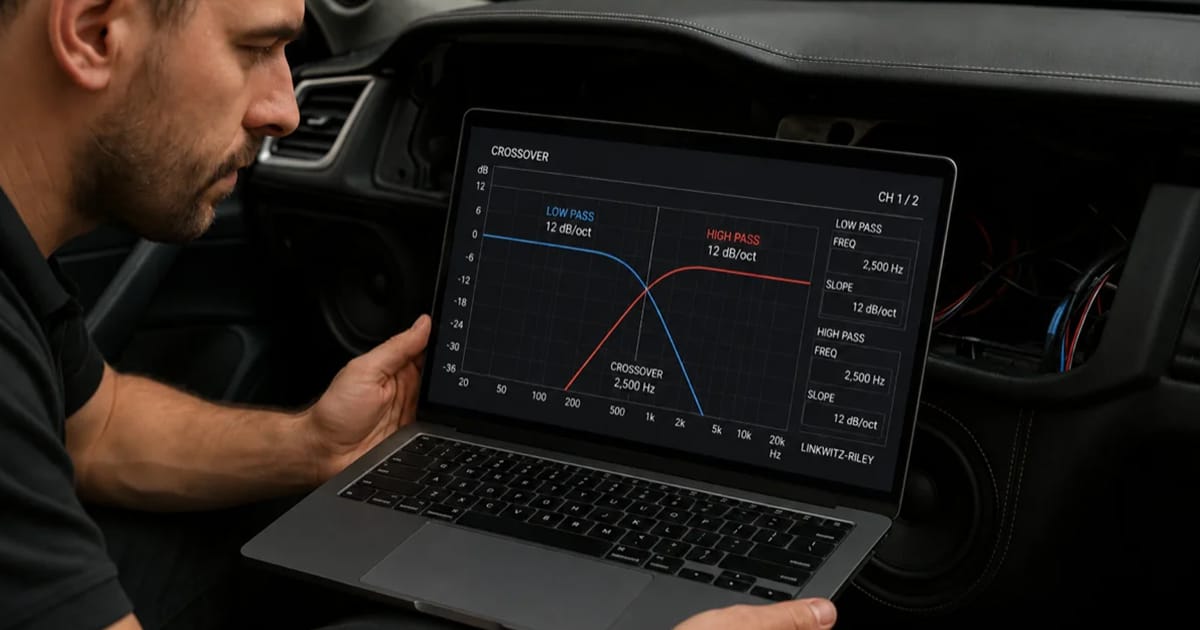
Two identical vehicles pull up at a red light, both playing the same song at the same volume. One sounds crystal clear with perfect separation between instruments. The other sounds muddy, with bass bleeding into the midrange and harsh treble. The difference? Crossover slope settings. This seemingly technical specification plays a massive role in how any car audio system performs, yet most enthusiasts overlook its importance.
Understanding Crossover Slope Basics
A crossover slope describes how quickly audio frequencies are reduced beyond a selected crossover point. Measured in decibels per octave (dB/octave), this slope functions as the foundation for proper speaker integration in any multi-way audio system.
Think of a crossover slope like a volume control that only affects certain frequencies. If a tweeter has a crossover point set at 3,500 Hz with a 12 dB per octave slope, the tweeter will receive full power at 3,500 Hz, but signals at 1,750 Hz (one octave lower) will be reduced by 12 dB. Signals at 875 Hz (two octaves lower) will be reduced by 24 dB. This gradual reduction prevents the tweeter from trying to reproduce bass frequencies it cannot handle effectively.
The selected slope determines how much unwanted audio reaches each speaker, directly impacting clarity, distortion levels and overall sound quality. A slope that’s too shallow allows excessive out-of-band frequencies to reach speakers, causing distortion and potential damage. Slopes that are too steep can create audible gaps or phase issues between drivers.
When a midrange speaker receives too much bass content due to a shallow slope, the cone moves excessively, creating distortion in the critical vocal range. Similarly, when tweeters receive midrange frequencies they weren’t designed to handle, they produce harsh, fatiguing sound.
Common Crossover Slope Options Explained
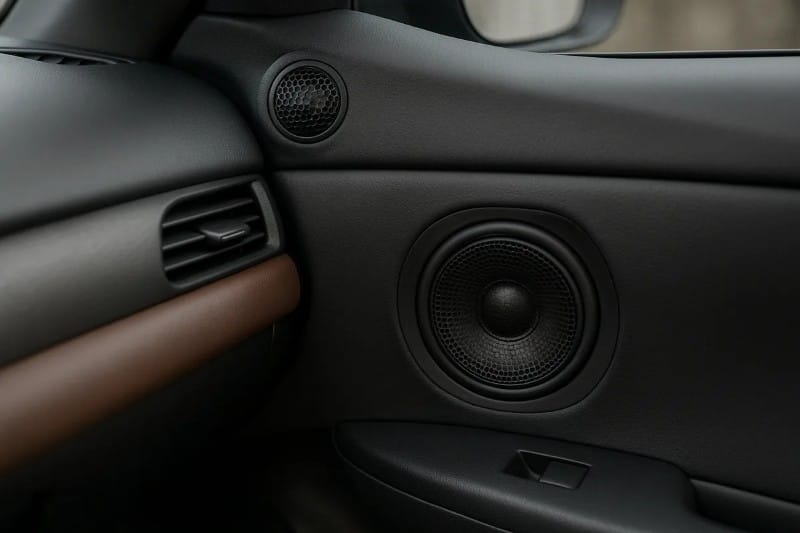
Most car audio systems use slopes of 6 dB, 12 dB, 18 dB or 24 dB per octave. Each option offers distinct sonic characteristics that suit different applications.
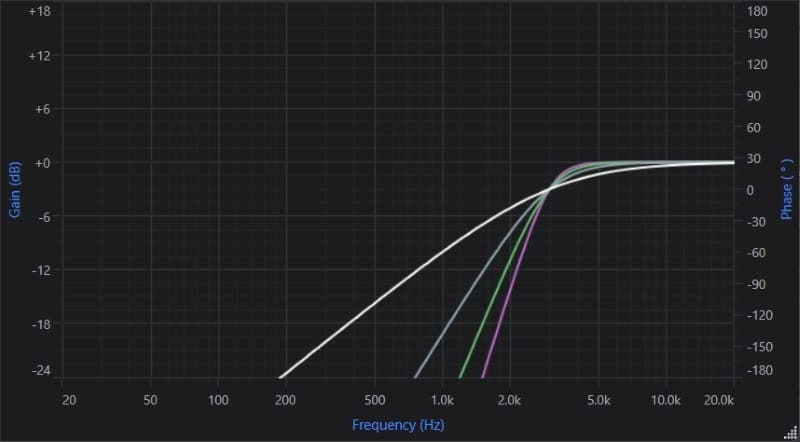
A 6 dB per octave slope provides the gentlest frequency roll off. This shallow slope allows significant overlap between drivers, which can help create seamless blend but requires speakers with extended frequency response. Many vintage audio systems used 6 dB slopes because they preserved phase coherence between drivers.
The 12 dB per octave slope represents the most common choice in car audio. At this slope, frequencies one octave away from the crossover point are reduced to about 25% of their original level. This provides reasonable protection while maintaining good phase relationships. Factory audio systems frequently employ 12 dB slopes because they work well with various speaker designs.
The 18 dB per octave slope offers increased protection with steeper frequency reduction. Professional installers often select 18 dB slopes when dealing with smaller tweeters or when speakers are pushed harder for competition output. The steeper roll off reduces distortion and increases power handling.
The 24 dB per octave slope provides maximum driver protection. Competition systems frequently use 24 dB slopes to ensure speakers only reproduce their optimal frequency ranges. However, this steep slope can create integration challenges, potentially causing audible gaps between drivers.
How Crossover Slope Affects Speaker Performance
Different slope choices influence how smoothly drivers blend together, affecting soundstage, tonal accuracy and listening realism. Shallow slopes create wider overlap regions where multiple speakers reproduce the same frequencies. This can enhance coherence but increases potential for destructive interference if speakers aren’t properly aligned. Steeper slopes minimize overlap, reducing interference but requiring precise level matching.
Vehicle dimensions, materials and speaker placement influence which slopes deliver optimal sound quality. A compact car with close speaker spacing might benefit from steeper slopes to minimize interference, while a large SUV might sound better with gentler slopes.
Reflective surfaces create acoustic complications that proper slope selection helps address. Professional installers use analyzers to measure in-vehicle response, then select slopes that complement the acoustic environment.
Passive vs. Active Crossovers and Slope Control
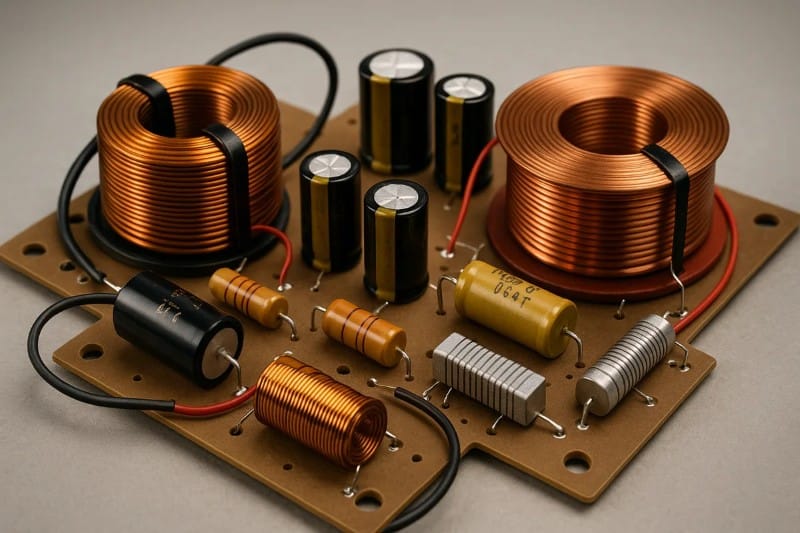
Traditional passive crossover networks offer limited slope options built into the speaker design, while active crossovers provide adjustable slope control. Passive crossovers use capacitors, inductors and resistors to create fixed slopes.
Active crossovers process audio signals before amplification, offering variable slope selection from 6 dB to 48 dB per octave, independent control over each speaker’s slopes, real-time adjustability, and phase alignment capabilities.
Why There’s No “Best” Crossover Slope
The correct slope depends on speaker capabilities, amplifier power, vehicle acoustics and system goals. A competition system requires different choices than a daily driver focused on natural reproduction. High-efficiency speakers can handle shallower slopes than lower-efficiency counterparts.
Complex slope adjustments require specialized equipment and expertise. Professional installers possess the tools to measure actual system response and select slopes that deliver desired results.
Ready to optimize your car audio system’s crossover slopes? Visit the BestCarAudio.com Dealer Locator to find qualified professionals who understand proper slope selection and can maximize your system’s performance.
This article is written and produced by the team at www.BestCarAudio.com. Reproduction or use of any kind is prohibited without the express written permission of 1sixty8 media.

Leave a Reply